What Are Mitochondria?
Deep inside nearly every cell in the human body are tiny structures working constantly to keep you alive, alert, and functioning. You cannot see them, feel them, or consciously control them — yet they influence everything from how energetic you feel in the morning to how well your muscles recover after activity.
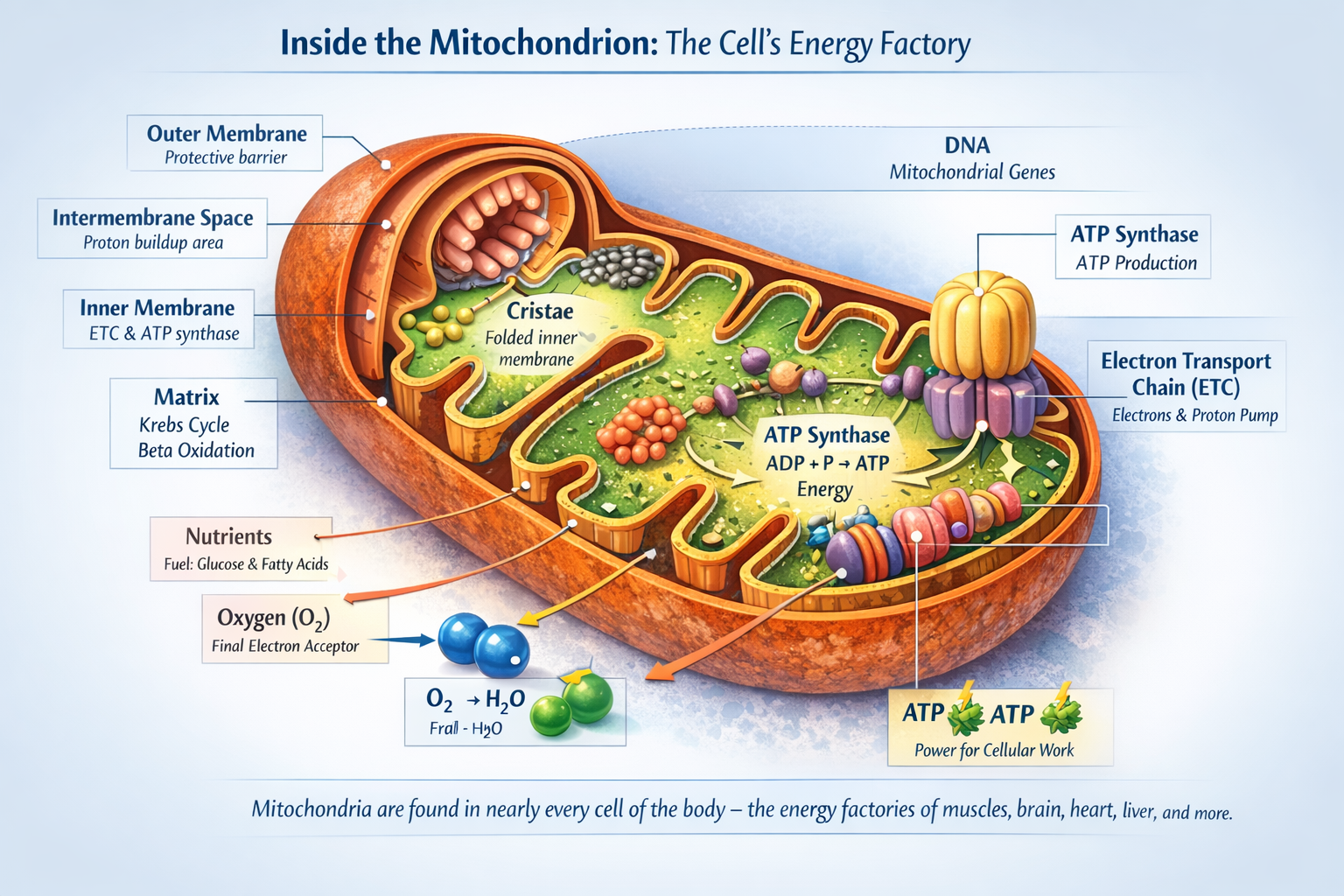
Mitochondria are best known for one essential job: converting the energy in food into a form your cells can actually use. That usable energy is packaged as ATP (adenosine triphosphate). Think of ATP as the "spendable" energy currency of the body: whenever a cell needs to do work — contract a muscle fibre , transmit a nerve signal , build a protein, repair damage, or maintain temperature — ATP is the immediate fuel that makes it possible.
Mitochondrial health isn't about chasing a miracle ingredient. It's about supporting the system: stable fuel supply, the right micronutrients , sensible movement, oxygen delivery , and recovery.
Where They Are (and Why That Matters)
Some cells contain only a few mitochondria. Others contain thousands. The number tends to reflect how demanding the job is. Your heart never gets a day off, so heart cells are densely packed with mitochondria. The brain is also energy-hungry — not because it is "thinking hard" all day, but because it is constantly maintaining signalling networks , ion balance , and repair. Your muscles need rapid energy for movement and longer-term energy for endurance and recovery.
This is one reason mitochondria sit at the centre of whole-body health. If energy production runs smoothly, tissues can perform their basic tasks with less strain. If energy production is inefficient or disrupted, the body can compensate for a while — but the "cost" often shows up as fatigue, poor exercise tolerance, slower recovery, brain fog , cravings, or metabolic instability .
How Mitochondria Make Energy (the simple version)
Mitochondria generate ATP by processing energy from carbohydrate, fat, and sometimes amino acids. Most of this happens through oxygen-dependent chemistry (often called "aerobic metabolism "). The important point for now is that mitochondria don't just need calories — they need the right supporting materials to run their chemistry efficiently: oxygen, enzymes , and a steady supply of micronutrient cofactors .
Mitochondria: Not Just "Power Stations"
The "power station" analogy is useful — but mitochondria do more than generate ATP. They also help regulate: signalling molecules , stress responses , inflammation balance , and cellular clean-up and renewal . They respond to your environment: food patterns, sleep, movement, stress, and overall nutrient availability.
In other words, mitochondria aren't just equipment you "own". They are a living, adaptive network. They can become more efficient when conditions are supportive — and less efficient when the system is under strain. This series is about understanding those conditions and learning how to build them consistently.
This information is educational and evidence-based, but it does not replace medical advice. If you have persistent fatigue, unexplained weakness, breathlessness, chest symptoms, or rapid changes in health, speak with your clinician.